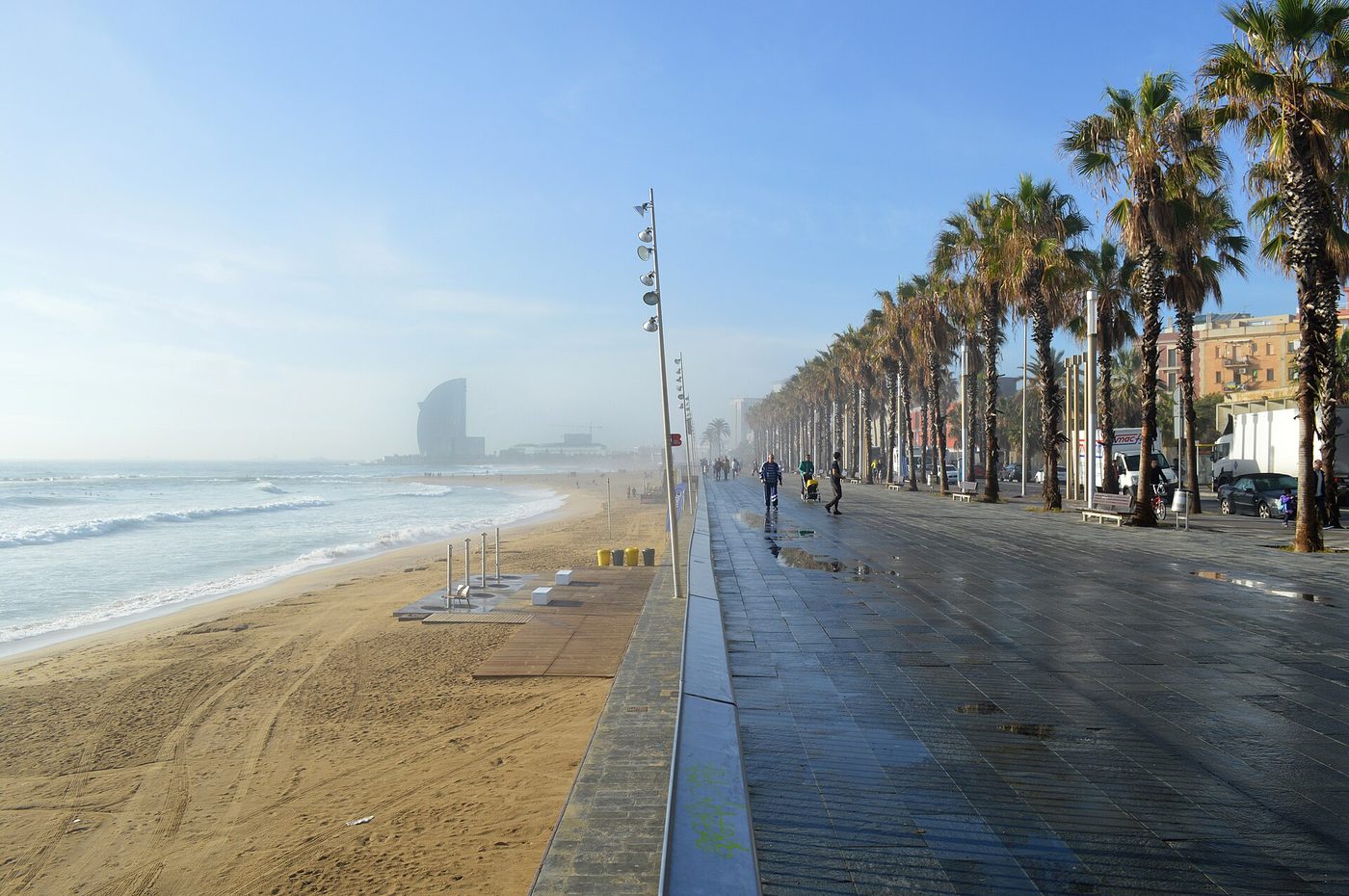
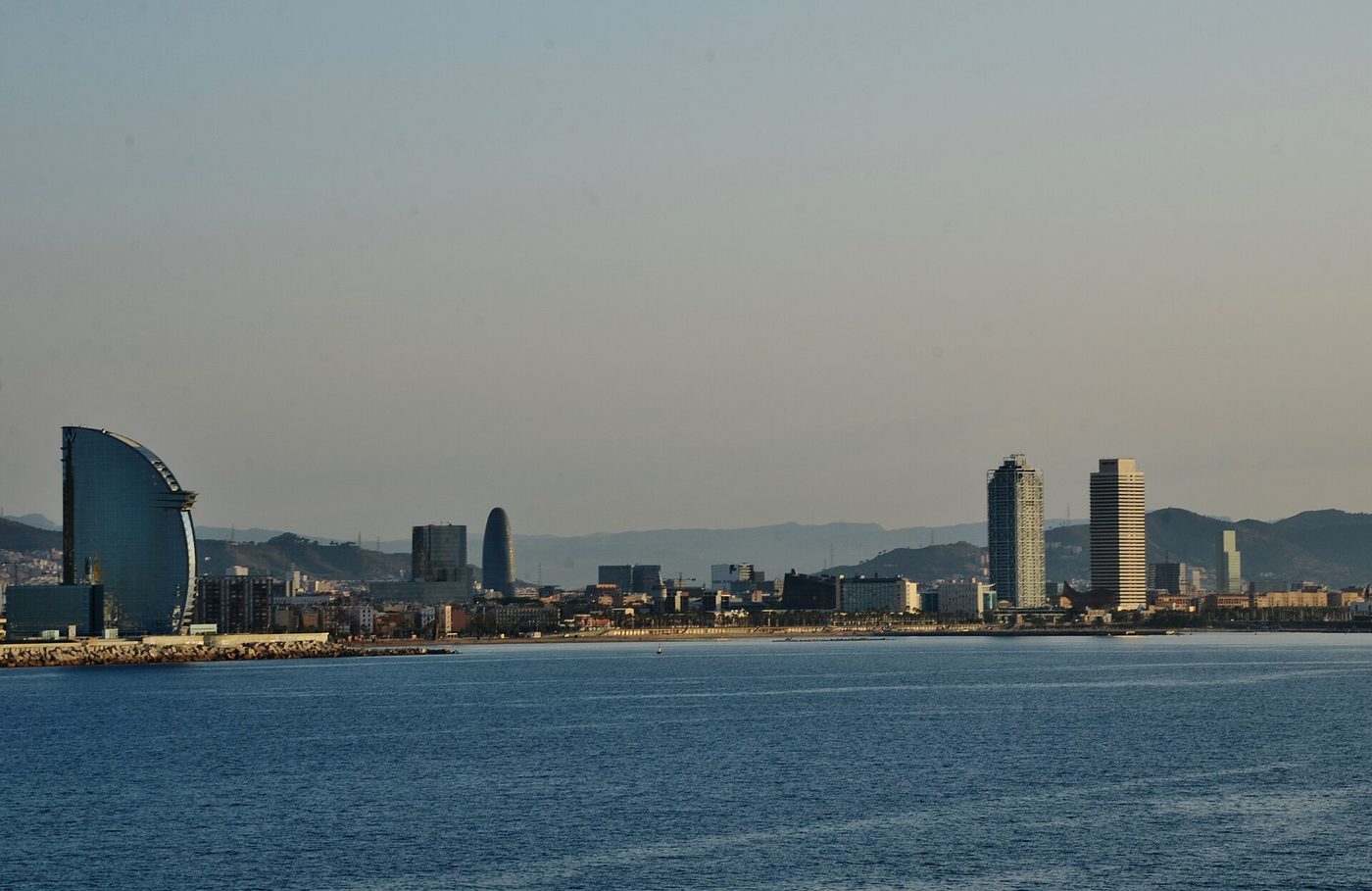
Barcelona's shoreline runs for about five kilometres of promenade from Barceloneta to Poblenou. At seven in the morning, before the visitors arrive, the dry air and the sun rising out of the sea wake the body from the inside. Our stay programmes deliberately build in time to walk this seafront between tests and treatments. This article explains what walking by the sea does for the body, how a different climate plays into it, and what people on our programmes have noticed.
Key takeaways
- Walking in morning light resets the body clock and clears jet lag faster
- The Mediterranean's low humidity and reliable sunshine act on sleep and mood differently from a humid Japanese summer or a grey northern winter
- Alternating promenade and sand works the small muscles of the feet and calves that city life leaves idle
- Walking therapy is not a substitute for treatment; it is the foundation that helps testing and treatment do their work
DimiTalen / CC0 — Wikimedia Commons
Part 1: Why walk by the sea
1. Light sets the body clock
Travelling from Japan means a seven- or eight-hour time difference; from the U.S. East Coast, six. For the first few days you wake at night and fade in the afternoon. One of the fastest ways out is to move your body in local morning light. Morning sun resets the internal clock and shifts evening melatonin to local time, and the seafront, with nothing in the way, lets you take in that light fully.
2. Low humidity, stable temperatures
Barcelona's average humidity is clearly lower than that of Japan's Pacific-coast cities, and sweat dries quickly even in summer. In a Japanese rainy season or a humid August, walking itself is a burden; here, half an hour leaves no discomfort behind. Winters hover around ten degrees, unlike the grey Sea of Japan coast or the cold, dry Kanto winter, so the outdoors stays usable all year.
3. Sand as uneven ground
Alternating paved promenade with sand engages the senses of the soles and the small muscles of the ankles and calves. Urban life offers only flat floors, and these muscles weaken. Even a few minutes barefoot on the sand sends signals from the feet that change posture throughout the body.
Part 2: What people on our programmes have noticed
A woman in her fifties walked the seafront the morning after arriving and said it felt "as if a fog had lifted from my head." At home she walked only to the station; she had not realised how much of her life was spent indoors.
A man in his forties expected sleepless nights from jet lag, but after three mornings of walking he was sleeping on local time from the fourth day. The morning walk is the one habit he has kept since returning home.
These are individual impressions, and not everyone experiences the same change. What most people share is the realisation that when the environment for moving your body changes, the body's response changes too.
Part 3: How a different climate works on the body
Japan's climate is rich in seasonal variety but hard on the body several times a year: the humidity of the rainy season, the heat of summer, the dryness and cold of winter. Conditions such as atopic dermatitis and asthma often flare at the change of seasons, and pressure changes bring headaches and fatigue. Northern U.S. and European winters bring their own problem of short, dark days.
The Mediterranean climate is mild in both temperature and humidity across the year. With less dryness and less sweat irritating the skin, some people find skin symptoms settle. Long daylight hours support vitamin D synthesis and steadier mood. The strong summer sun does demand sunscreen and a hat.
The essential point is that climate is not a treatment. It simply provides an environment in which the body's own capacity to recover can operate more easily. That is exactly why it makes sense to combine it with testing to understand where you stand, and with treatment at a physician's discretion.
Maria Rosa Ferre / CC BY-SA 2.0 — Wikimedia Commons
Part 4: Where it sits in our programme
Walking therapy is built in as the foundation of every stay.
- Morning after arrival: a 30-minute walk to start adjusting the body clock
- Test day: blood is drawn fasting, so a short walk afterwards before breakfast
- Day after a treatment: rest on treatment day, then walk gently the next day, following any instructions from the physician
- Nutrition counselling day: a "food walk" through the markets looking for the ingredients recommended in your session
A coordinator can accompany you or you can walk alone. If you track steps and heart rate with an Apple Watch or Oura ring, comparing data from before and after the stay makes changes visible and feeds into your follow-up.
Part 5: Recommended routes
- Barceloneta to Port Olímpic: about 2.5 km, flat and easy, with plenty of morning cafés
- Port Olímpic to Poblenou beach: about 2.5 km, few tourists, the locals' running route
- Montjuïc hill: once the flat seafront feels easy, an advanced route with gradients to challenge the heart and lungs
All are about fifteen minutes by metro from our office on Rambla de Catalunya.
Part 6: Points to keep in mind
- If you have heart or joint conditions, check walking intensity with the physician in your pre-consultation
- In summer, avoid direct sun after ten in the morning and drink plenty of water; use sunscreen even in winter
- When walking barefoot on sand, watch for glass and start with short distances
- Seafront walking does not guarantee the effect of any treatment; it is a supporting habit for keeping the body in good condition
Summary
Time spent walking the Barcelona seafront is neither a test nor a treatment, but the time you spend clearing jet lag, taking in light and moving idle muscles is what builds the foundation of the whole stay. Observing how your body responds in a climate unlike home also prompts a fresh look at your habits after you return. Our programmes build in walking time around tests and treatments, with a coordinator alongside whenever you want one.
Talk to us about testing and treatment in Europe
From testing and stem cell secretome therapy at partner clinics in Barcelona to arranging your stay, we coordinate everything in English and Japanese. The online pre-consultation is free.
Request a Free Pre-Consultation